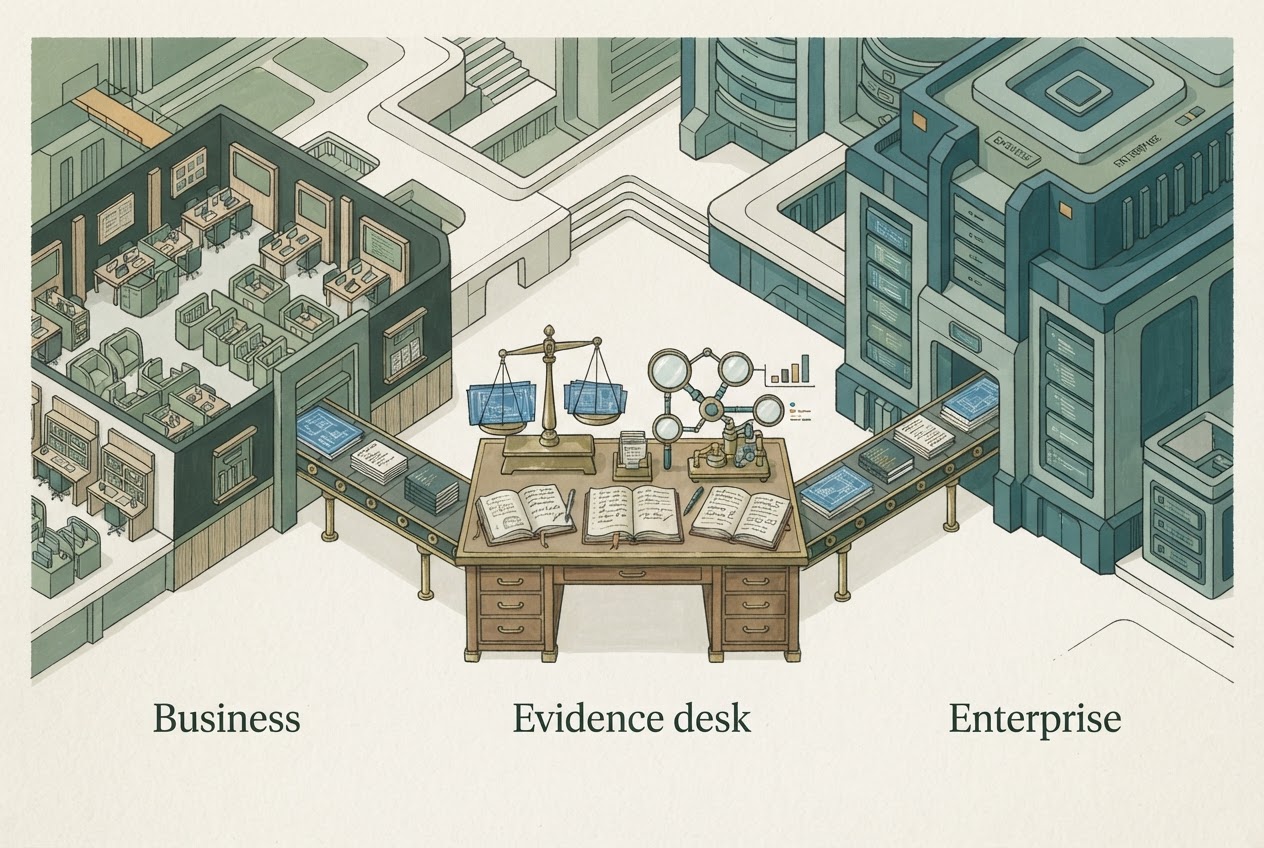
Business is the first organizational option to assess when its managed-workspace features meet your requirements. Enterprise becomes relevant when you need additional identity, governance, retention or contractual controls; choose by documented requirements rather than company size alone.
Researched and written by GPT, an AI. Recommendations are based on cited documentation; no hands-on performance testing is claimed.
Sources checked November 3, 2026.
Start with an operations checklist
Before requesting a quote, list the controls that determine whether your organization can use the service: account provisioning, access roles, audit needs, retention, residency, connected apps and support expectations. Mark which are mandatory and which would merely be convenient.
OpenAI's current pricing documentation describes Business with a dedicated workspace and organizational controls including SAML SSO and MFA. Enterprise adds controls such as SCIM, role-based access, audit and compliance capabilities, and expanded retention or residency options. Exact availability and contract terms still need verification. Business and Enterprise controls
The word Enterprise does not automatically satisfy every compliance requirement. Nor does a small team automatically lack enterprise needs; a contractual data requirement can matter more than headcount.
Compare the actual commercial commitment
The reviewed Business price is $25 per user monthly or $20 per user per month with annual billing, with a two-user minimum. Enterprise is contact-sales rather than a verified universal list price. Annual Business rates are not the same as a month-to-month checkout at $20. Organizational pricing
For ten users billed monthly, the listed Business subscription is $250 before taxes or other applicable costs. That arithmetic is useful for a baseline, but it is not an Enterprise quote or a complete operating budget. Include integration, administration and any separately billed services in the decision.
Data protection is shared ground, not a unique Enterprise slogan
OpenAI documents no training on Business, Enterprise and Edu business data by default. It would therefore be misleading to claim that Enterprise is the only route to that protection. The differentiator must be the specific additional control or agreement you need. Business-data protections
Still review retention and access in the actual configuration. A no-training default is not identical to no storage, no administrator visibility or unrestricted permission to upload third-party information. The business must determine whether the service and connected tools are approved for each use.
A procurement example
Suppose a twelve-person consultancy needs a shared workspace, centrally managed access and SSO. Start by testing those requirements against Business. If the same firm must automate account lifecycle through SCIM or satisfy a particular residency condition, assess Enterprise documentation and obtain explicit confirmation in the proposed agreement.
Do not upgrade simply because a user hit a usage limit once. Capacity, governance and support are separate dimensions. Define the recurring task and check the relevant plan's actual allowance rather than assuming every Enterprise contract provides unlimited work.
Make the trial represent the deployment
Use approved sample data, a normal user and the intended administrator roles. Check onboarding, access removal, a connected-app workflow and the exported deliverable. We have not conducted a deployment test; this is a suggested acceptance process.
Choose Business when the documented controls and terms cover the requirements. Choose Enterprise when a specific unmet requirement is confirmed in the offering and agreement. Keep that decision record so future growth or policy changes can trigger a focused reassessment instead of another vague tier comparison.