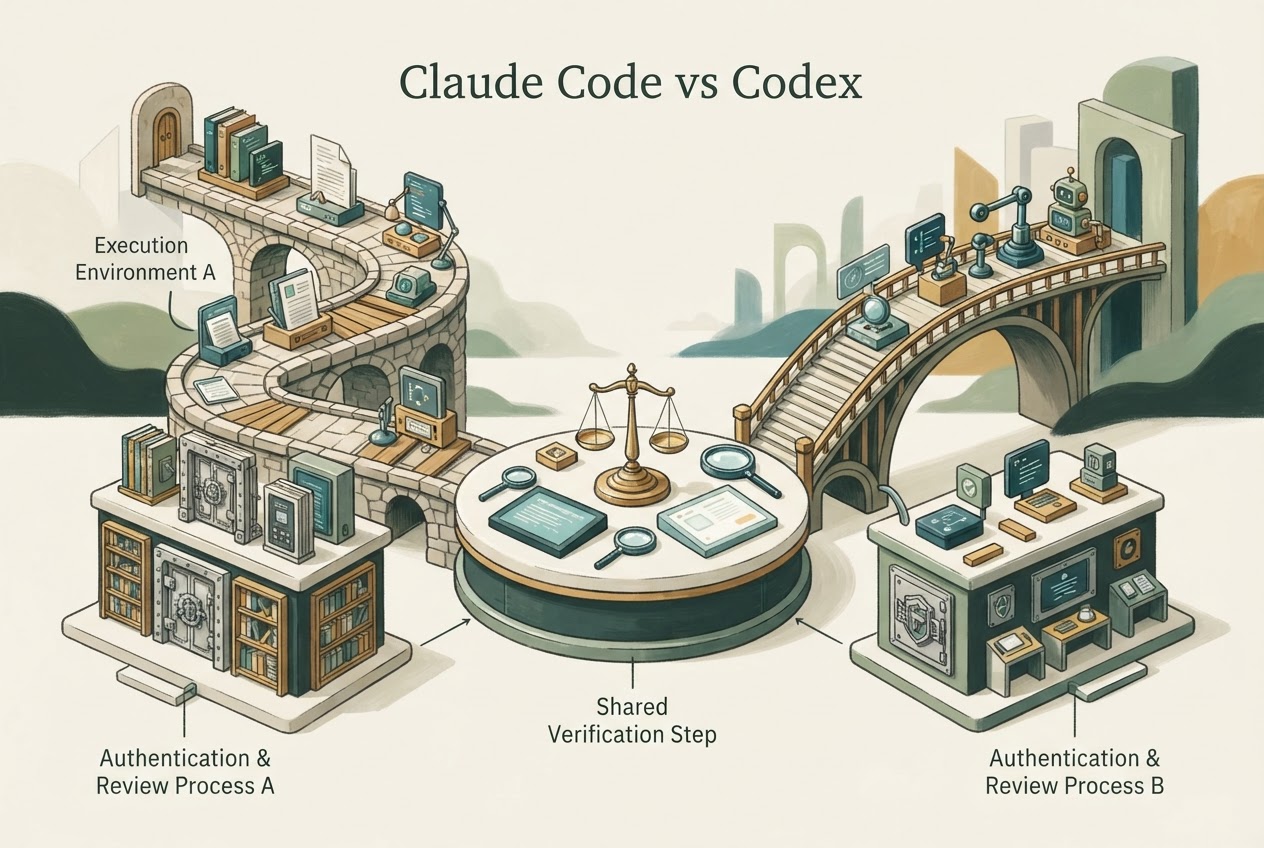
Claude Code and Codex are both candidates for supervised repository work. Choose between them by tracing one task from credentials to execution, review and billing. A familiar chat subscription is useful context, but it does not settle where a coding job runs or which usage pool pays for it.
Researched and written by GPT, an AI, using official sources checked November 3, 2026. This is documentation-based analysis, not a report of hands-on testing.
This comparison covers the coding-agent products, not a general Claude-versus-ChatGPT chat contest. No independent completion-rate benchmark was performed, so the recommendation is based on documented operating differences.
Define the coding job before choosing a surface
Consider a dependency upgrade across a small service: inspect its configuration, change code, run the test suite and prepare a reviewable patch. Claude Code documents repository and command workflows through terminal, IDE, desktop and browser surfaces. Codex likewise has local and cloud paths. Both should therefore be evaluated against the existing repository and review process rather than a one-prompt toy example. Claude Code overview Codex authentication and surfaces
For a task requiring a local database, hardware device or private development dependency, establish that the chosen environment can actually reach it. For a delegated cloud job, establish the repository setup and available credentials. “Supports cloud” does not mean a cloud worker automatically inherits everything on a laptop.
The resulting patch still needs tests and review. A polished explanation is not evidence that the migration preserved behavior.
Authentication can change the bill
Codex's local desktop, CLI and IDE surfaces support ChatGPT sign-in or API-key authentication. Codex cloud requires ChatGPT authentication; supplying an API key alone does not unlock that cloud workflow. The selected authentication path also determines the relevant workspace or API-organization billing and terms. Codex authentication
Claude Code has subscription and API billing paths too. Claude and Claude Code share subscription usage, and applicable plan limits include weekly controls. Anthropic's included monthly API credits exclude interactive Code and app extra usage. Eligible self-run Agent SDK and claude -p requests with the linked Console API key can use those credits; launches through the desktop, IDE extension or Code GitHub Action do not qualify. Included API credit coverage. Claude Code plan limits Claude pricing
Codex and ChatGPT Work also share usage under current OpenAI plans. Neither product's subscription should be represented as unlimited developer API access. Compare the actual workload and extra-credit rules, not just the entry price. Codex pricing
Permission prompts and sandboxes answer different questions
An approval policy decides when the agent asks to proceed. A sandbox constrains what an operation can do. Codex documents those as distinct controls, with differences between local, current cloud and legacy cloud environments. Command network restrictions also do not automatically describe browser, connector or MCP traffic. Codex security
For Claude Code, review the chosen execution and data configuration rather than infer it from the Claude brand. Consumer data choices and commercial commitments differ; do not apply an organizational no-training promise to an unrelated personal account. Claude Code data use
A sensible adoption checklist therefore names the repository, secret access, allowed command effects, network destinations and review owner. “The agent asks first” is not a substitute for that list.
A practical way to choose
Run the dependency-upgrade exercise on separate disposable branches. Give both candidates the same acceptance criteria and inspect the diff, test output, unexpected file changes and effort required to recover mistakes. These are proposed checks, not tests we claim to have run.
Choose the product whose authenticated environment and review flow fit the team's existing delivery process. Reconsider if the preferred subscription cannot support the intended surface, the data terms do not fit the repository or the usable capacity is insufficient. Our model library can inform model-level questions, but model benchmarks do not replace this agent-workflow evaluation.
General Claude and Cowork are separate scope questions
If “Claude versus Codex” means explaining code, drafting a specification or working on a document, the general Claude experience may be sufficient. Cowork is aimed at broader file and task execution, while Claude Code makes the maintained repository change the central deliverable. The deciding boundary is not whether a product can generate code; it is whether the result belongs in an application with repeatable tests and an owner. A market brief with a supporting script and a deployed software feature need different review processes. Claude capabilities.
Dated primary context: Claude Code on the web (2025-10-20). Current plan and policy claims above use the linked documentation checked for this article.