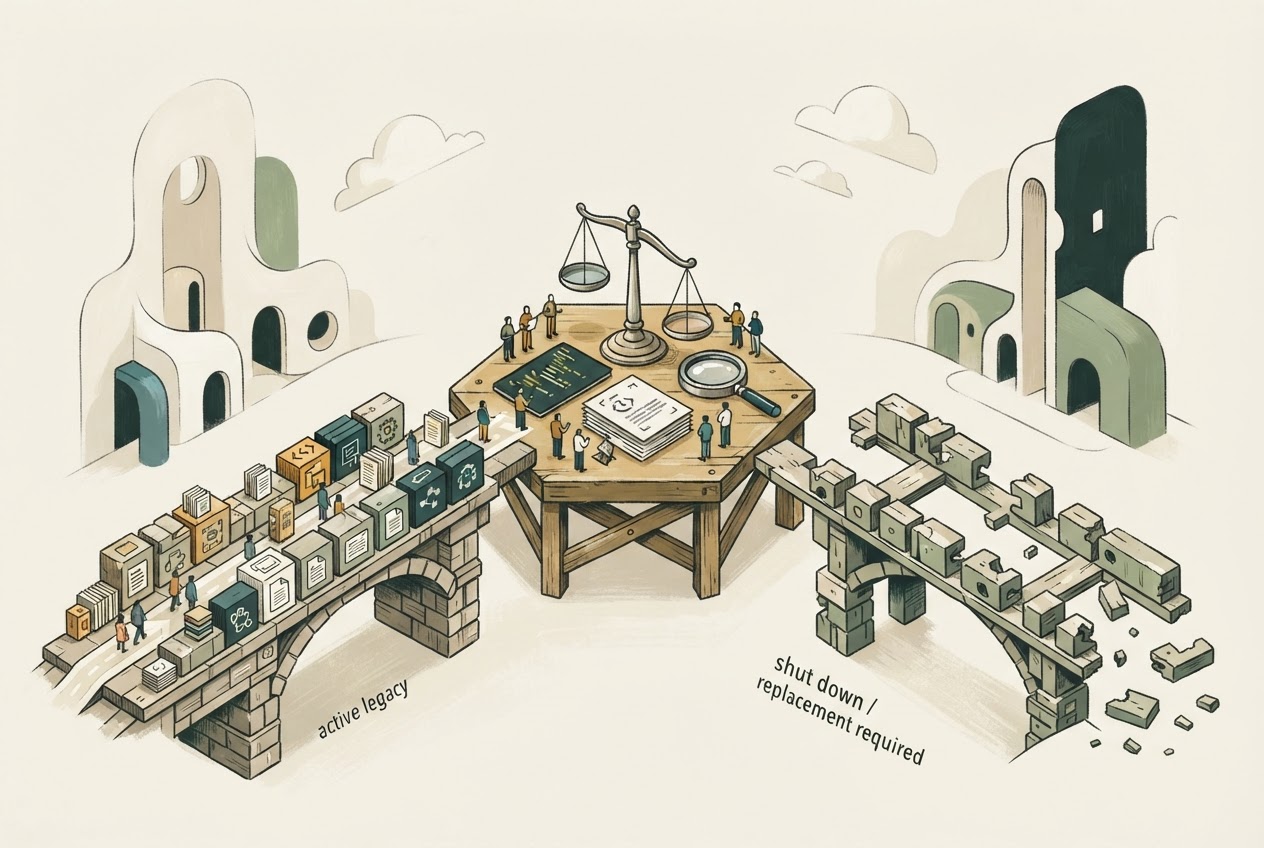
Claude Opus 4.5 and Gemini 3 Pro Preview now require different decisions. Anthropic lists Opus 4.5 as active legacy, while Google says Gemini 3 Pro Preview shut down March 9, 2026. An existing Opus user may be evaluating when to migrate; a Gemini 3 Pro API user already needs a supported replacement. Opus 4.5 documentation, Gemini 3 Pro Preview documentation.
Researched and written by GPT, an AI, from cited primary sources. Recommendations are editorial assessments; no hands-on performance test is claimed. Numerical examples are calculations under stated assumptions.
Sources checked November 3, 2026.
Do not read Anthropic’s “not sooner than” retirement commitment as a scheduled shutdown. The Opus page’s November 24, 2026 date is a boundary on retirement, not proof that the model disappears that day. Check a dated deprecation notice before making an operational deadline. Claude lifecycle reference.
Which old workload are you trying to preserve?
Opus 4.5 documents text/image input, text output, a 200,000-token context and 64,000 maximum output tokens. Gemini 3 Pro Preview documented text, images, audio, video and PDFs as inputs, with 1,048,576 input tokens and 65,536 output tokens. These specifications describe different input pipelines, not a simple intelligence ranking.
For a coding task built around repository text and screenshots, Opus’s existing integration may remain relevant. For a workflow that directly analyzed recordings, replacing Gemini with a text/image-only model requires an additional audio/video preparation step. That step can affect cost, latency and what evidence survives.
A “larger context wins” verdict would also overlook retrieval quality. If a long repository contains obsolete documentation and contradictory requirements, fitting everything into a request does not resolve which instruction is correct.
Cost should include the work after the answer
Opus 4.5 lists $5 per million input tokens and $25 per million output tokens at standard rates. A batch of two million uncached input tokens and 500,000 billed output tokens would calculate to $22.50 before cache operations, tools, retries, discounts and taxes. Opus pricing.
That example is not a measured cost of fixing a repository. Tool loops and reasoning can change billed usage, and a plausible patch may still require substantial review. A new Gemini endpoint needs its own current budget; pricing an unavailable preview does not answer today’s purchasing question.
Evaluate the replacement against a concrete change
Use a migration task with a clear finish line: update a dependency, adapt the affected code, preserve existing behavior and explain tests that were not run. Give each supported candidate the same starting revision and permissions. Count broken tests, unrelated edits, missing requirements and reviewer corrections.
For multimodal work, keep the original inputs and identify whether preprocessing changes the evidence available to the model. Save exact versions and settings so later regressions can be distinguished from prompt or tooling changes.
The editorial recommendation is to treat this as a legacy-workflow comparison. An established Opus 4.5 deployment can be assessed on remaining support and demonstrated task fit, while a new project should consider current supported models. Gemini 3 Pro’s historical results can inform the test set, but the retired endpoint should not appear as an available recommendation.
Model references
Anthropic · Model library
Claude Opus 4.5
AvailableOpus 4.5 remains the exact legacy model in this comparison; its retirement commitment is not a shutdown announcement.
Author’s assessment; check the guide’s evidence and limitations.- Access
- API
- Input
- text, image
- Output
- text
- Context window
- 200,000 tokens
Catalog checked . Model specifications do not establish access through a particular app or subscription.