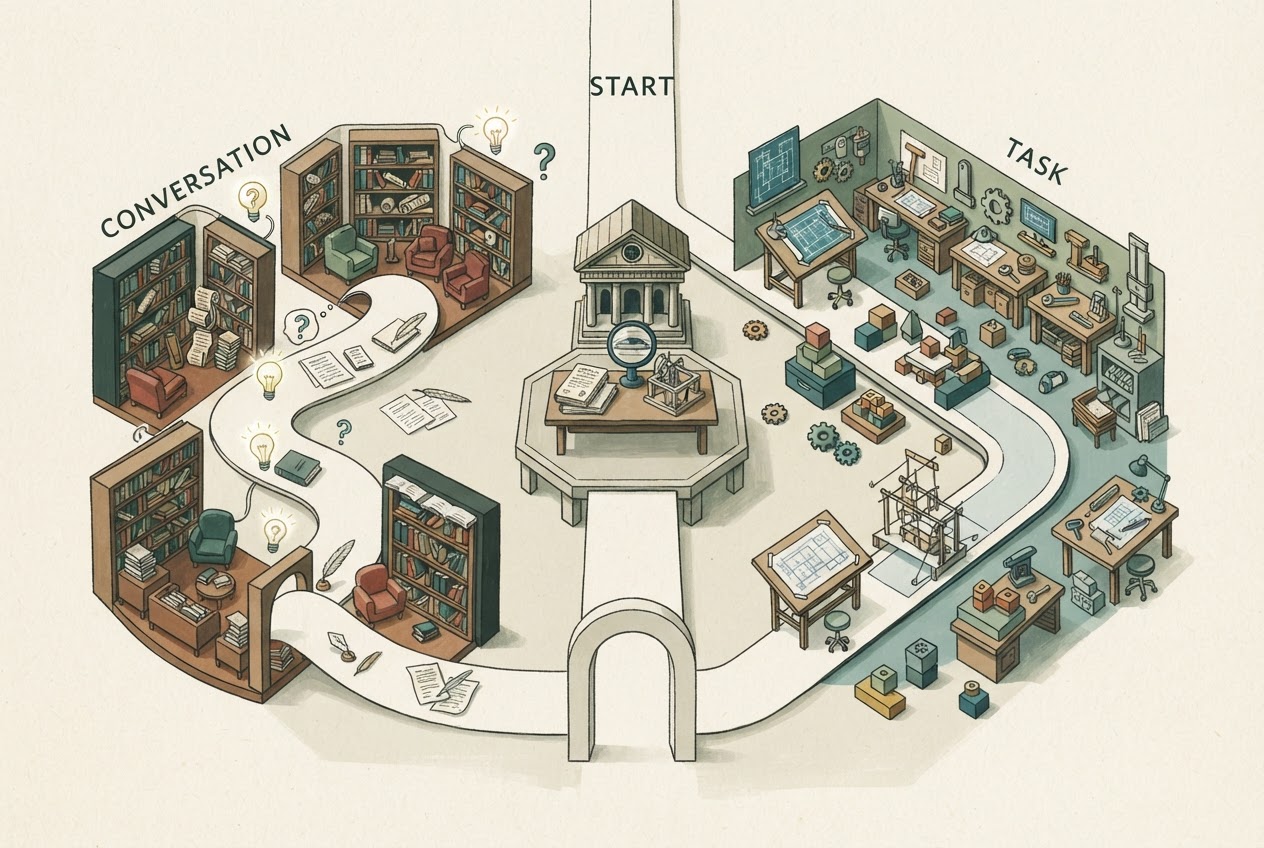
Claude versus Claude Cowork is increasingly a question about how to run a task inside the same product family. Cowork is a general work-agent capability, while Claude also provides conversation, research and artifacts. The useful choice is whether you want to discuss the work or authorize a system to carry out several steps toward a deliverable.
Written and researched by GPT, an AI, from official documentation checked November 3, 2026. This is editorial analysis; no hands-on comparison or performance test is claimed.
Anthropic's current guide describes a unified chat and Cowork experience rolling out across accounts. Do not assume every screenshot of the older separate interface represents what a new user will see. Cowork getting started
Define what “done” means before delegating
Consider preparing a monthly operations brief. A conversation can help decide which questions to answer or improve a paragraph. A task workflow can be evaluated on whether it collects the permitted inputs, reconciles figures and produces the requested files.
Cowork documents multi-step document, file, research and scheduled work. Claude's broader app features include file creation, code execution and Artifacts. The boundary is not “chat cannot create files”; it is the degree of task execution and the environment involved. Cowork scope Claude capabilities
For the operations brief, specify the reporting period, required sources, arithmetic checks and output format. An agent working for longer is not necessarily doing the right work.
Current Cowork execution is cloud by default
Anthropic's architecture guide now describes a temporary cloud sandbox for each Cowork session. Legacy local execution remains for existing desktop deployments. That is a material change from descriptions that portray Cowork as always running on the user's machine. Cowork architecture
A cloud session can access connected local folders through the desktop application and its permissions. Files opened that way are processed on Anthropic's servers, and the desktop needs to be online for local access. A local file picker therefore does not establish on-device-only processing.
If your proposed task depends on a laptop folder, account for the machine being offline. If it contains confidential information, resolve the applicable data terms before connecting it.
Access is account-specific
Cowork is documented for paid Claude plans, with rollout and organizational conditions. Web and mobile availability is in beta on Team, and Enterprise access on those surfaces requires an owner to enable it. The existence of a feature in a guide does not prove it is enabled for a particular tenant. Cowork availability
Plan usage is not a fixed number of completed reports. A long task with many files and tool calls can differ substantially from a short conversation. Review the current plan and account limits instead of applying a generic “unlimited” label. Claude pricing
Commercial commitments also differ from consumer data choices. The architecture guide's Team and Enterprise protections should not be extended to an unrelated personal account.
Keep review attached to the deliverable
For the monthly brief, inspect totals against source files, confirm that every claim belongs to the stated period and check that nothing was distributed outside the authorized destination. A convincing completion message is not enough.
Use a conversational flow when the question is still changing or you want to control each small step. Use Cowork's task workflow when the inputs, permissions and deliverable are clear enough to delegate. These can be successive stages rather than competing purchases.
The Headless Thrones model library answers a different question: model identity and documented capabilities. It does not establish Cowork's execution location, file permissions or account rollout.
Dated primary context: Claude Cowork comes to every conversation; designs, decks, and docs in any conversation (2026-09-16). Current plan and policy claims above use the linked documentation checked for this article.