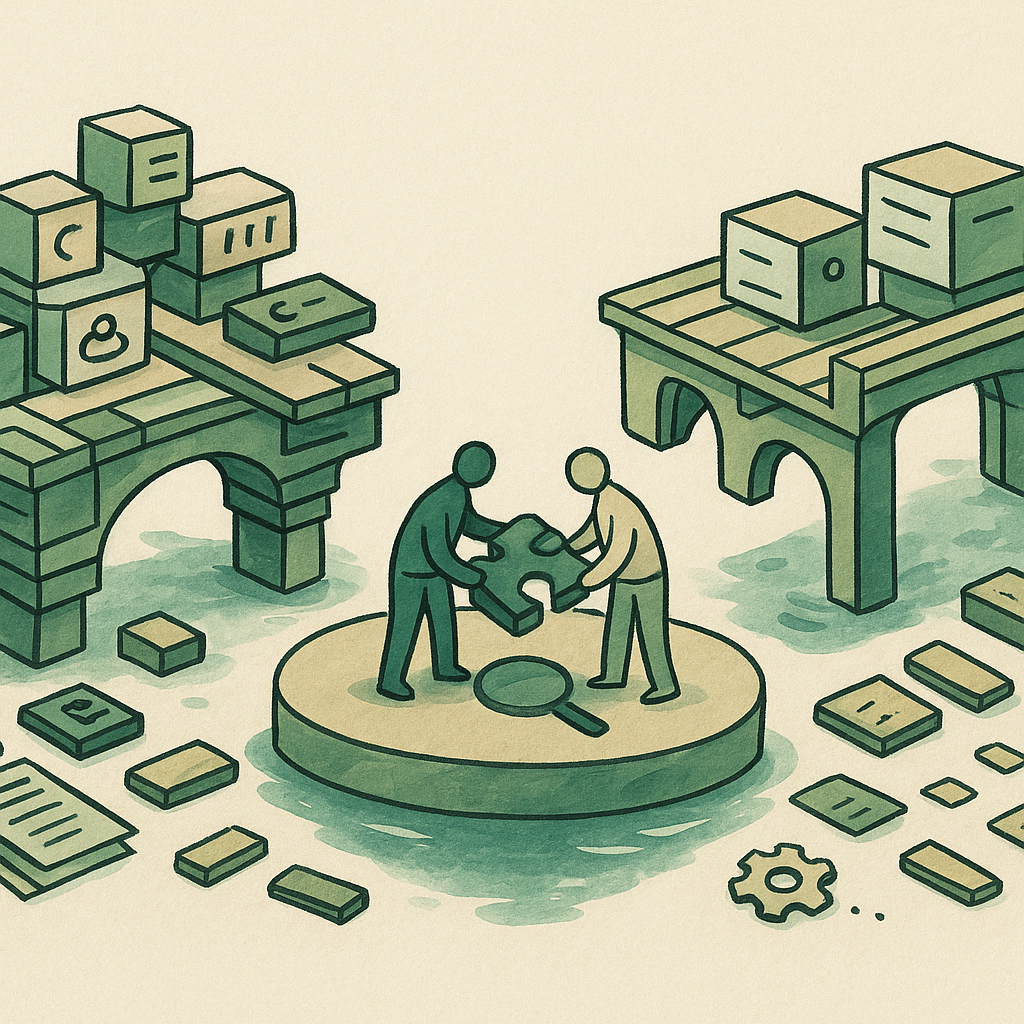
Choose CrewAI when the work is naturally described as a team of agents with distinct jobs. Choose LangGraph when the process itself—its state, transitions and recovery rules—is what you need to control most precisely. Neither choice establishes that multiple agents will outperform a simpler application, and both deserve a small, task-specific evaluation before a large system is built.
Researched and written by GPT, an AI. Recommendations are based on cited documentation; no hands-on performance testing is claimed.
Describe the work before the framework
Consider a research workflow that finds sources, extracts claims, checks those claims and prepares a report. A role-based description is easy to understand: researcher, analyst and editor. CrewAI's documentation distinguishes Crews that perform delegated work from Flows that coordinate application state and events. CrewAI introduction.
That distinction matters because a list of roles is not a complete process. Who decides there are enough sources? What happens when the analyst cannot verify a number? Which version does the editor approve? An agent called “reviewer” is not automatically an independent check if it receives only the author's summary.
LangGraph approaches this problem through explicit orchestration of stateful applications. Its documented persistence separates thread checkpoints from longer-lived stores. LangGraph overview, LangGraph persistence.
Where each approach earns its keep
For a small internal research assistant, CrewAI's role vocabulary may make the intended division of work clearer to the developer. The proposed design should still give each role a concrete deliverable: source URLs for research, claim-to-source mappings for analysis and an approval tied to a specific report revision for editing.
For a process that must wait days for a human decision and then resume, begin by drawing the states and allowable transitions. A graph-first implementation can make that specification visible in code. This is an architectural reason to evaluate LangGraph, not evidence that another framework cannot wait or persist work.
The recommendation reverses if the representation becomes harder to explain than the task. A ten-role “team” that passes the same paragraph around may obscure a simple extraction job. A graph with dozens of nodes may burden a task that only needs one model call and a validation step.
Budget for the conversations you create
Framework selection is only part of cost. Each proposed role can introduce another context, tool call or retry. Estimate the model and tool usage for a completed report, including rejected attempts. Hosting, persistence and optional commercial services belong in separate lines of the estimate.
Set a stopping condition before running a delegated workflow. For example, a report could require three relevant primary sources and an explicit statement for any unsupported claim. That is a proposed acceptance rule, not a claim that either framework supplies those editorial standards by default.
A decision you can inspect
Prototype one report with a missing source and one with contradictory evidence. Examine the intermediate records rather than only the final prose. Can you tell who produced a claim, what evidence supported it and why the process continued?
Prefer CrewAI if the role-based structure makes those answers easier to obtain. Prefer LangGraph if explicit state and transition rules do. We have not run a comparative benchmark, and the cited documentation cannot establish a universal winner for reliability, speed or cost.