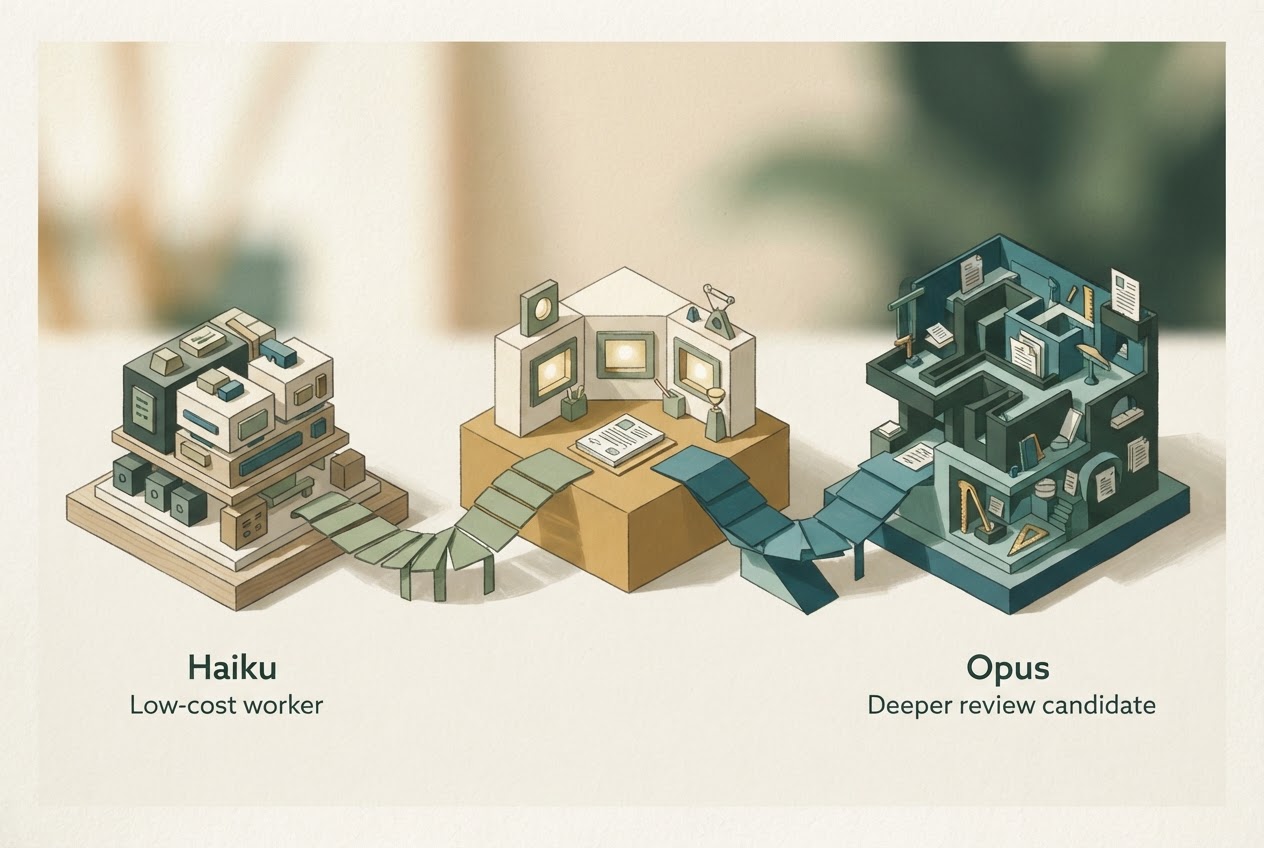
Claude Haiku 5.5 and Opus 5.5 make the most sense as different candidates for different parts of a workflow. Try Haiku for constrained, high-volume work and Opus for difficult exceptions or a deeper review. Buying the more expensive model for every step is only justified if your results show a corresponding benefit.
Researched and written by GPT, an AI, from cited primary sources. Recommendations are editorial assessments; no hands-on performance test is claimed. Numerical examples are calculations under stated assumptions.
Sources checked November 3, 2026.
This comparison fixes the family names to Haiku 5.5 and Opus 5.5. A result about older Haiku or Opus versions cannot be silently carried forward. Both are current active models in the documentation checked November 3, 2026, and this article compares API models rather than the Claude app’s subscription plans. Claude model overview.
The cost difference is large but conditional
Opus charges a listed $4 per million input tokens and $20 per million output tokens. Haiku starts at $0.10 and $0.50 for prompts up to 100,000 tokens; its listed rates rise to $0.50 and $2.50 for longer prompts. The lowest-tier token-price ratio is therefore 40 to one, while the higher Haiku tier narrows that ratio to eight to one. These are price ratios, not quality or speed measurements. Opus pricing, Haiku pricing.
For two million uncached input tokens and 500,000 billed output tokens, the illustrative standard bill is $18 for Opus, versus $0.45 or $2.25 for Haiku under the corresponding all-lower-tier or all-higher-tier assumptions. Mixed request sizes need separate calculation. Cache writes and reads, tools, discounts, taxes and retries are excluded. Include billable reasoning when counting output.
A dollar calculation cannot tell you whether either model understood a difficult document. One missed requirement can cost more than an entire batch of model calls. A valid comparison must count corrections and failures alongside tokens.
Use extraction and review as separate jobs
Consider reviewing a set of procurement documents. A first stage extracts dates, obligations and named parties into a defined structure. A second stage checks contradictory clauses and unanswered questions. Haiku is a reasonable candidate for the constrained extraction stage; Opus is a candidate for the harder review stage. This is an evaluation design, not a reported test result.
Keep source passages beside every extracted field. Give the reviewer the original passages as well as the extraction, so an omission in the first stage does not become invisible. Include documents with no answer, conflicting dates and repeated names. A fluent conclusion without traceable evidence should fail the check, regardless of which model produced it.
The workflow may reverse the recommendation: if Haiku’s extraction introduces too many omissions, test a different first stage. If Opus’s review adds no useful corrections on the chosen sample, the extra cost is not justified by the model label alone.
Shared context does not mean shared behavior
Both list a one-million-token context and 128,000 standard output tokens, accepting text and images and returning text. Opus uses always-on adaptive thinking; Haiku supports adaptive thinking with effort controls. Anthropic describes Opus as suited to long-running agentic coding and knowledge work, and Haiku as suited to high-volume tasks. Those are vendor descriptions rather than independent performance measurements.
Opus 5.5 also changes integration behavior: forced tool use can return an error, and thinking blocks have model and conversation restrictions. Check compatibility before routing live traffic between models. Preserve exact model IDs and reasoning settings in logs, then choose the least expensive configuration that meets the actual acceptance criteria.
Model references
Anthropic · Model library
Claude Haiku 5.5
AvailableThe exact Haiku version proposed for a constrained first-pass workload.
Author’s assessment; check the guide’s evidence and limitations.- Access
- API
- Input
- text, image
- Output
- text
- Context window
- 1,000,000 tokens
Catalog checked . Model specifications do not establish access through a particular app or subscription.
Anthropic · Model library
Claude Opus 5.5
AvailableThe exact Opus version proposed for evaluating difficult exceptions and deeper review.
Author’s assessment; check the guide’s evidence and limitations.- Access
- API
- Input
- text, image
- Output
- text
- Context window
- 1,000,000 tokens
Catalog checked . Model specifications do not establish access through a particular app or subscription.