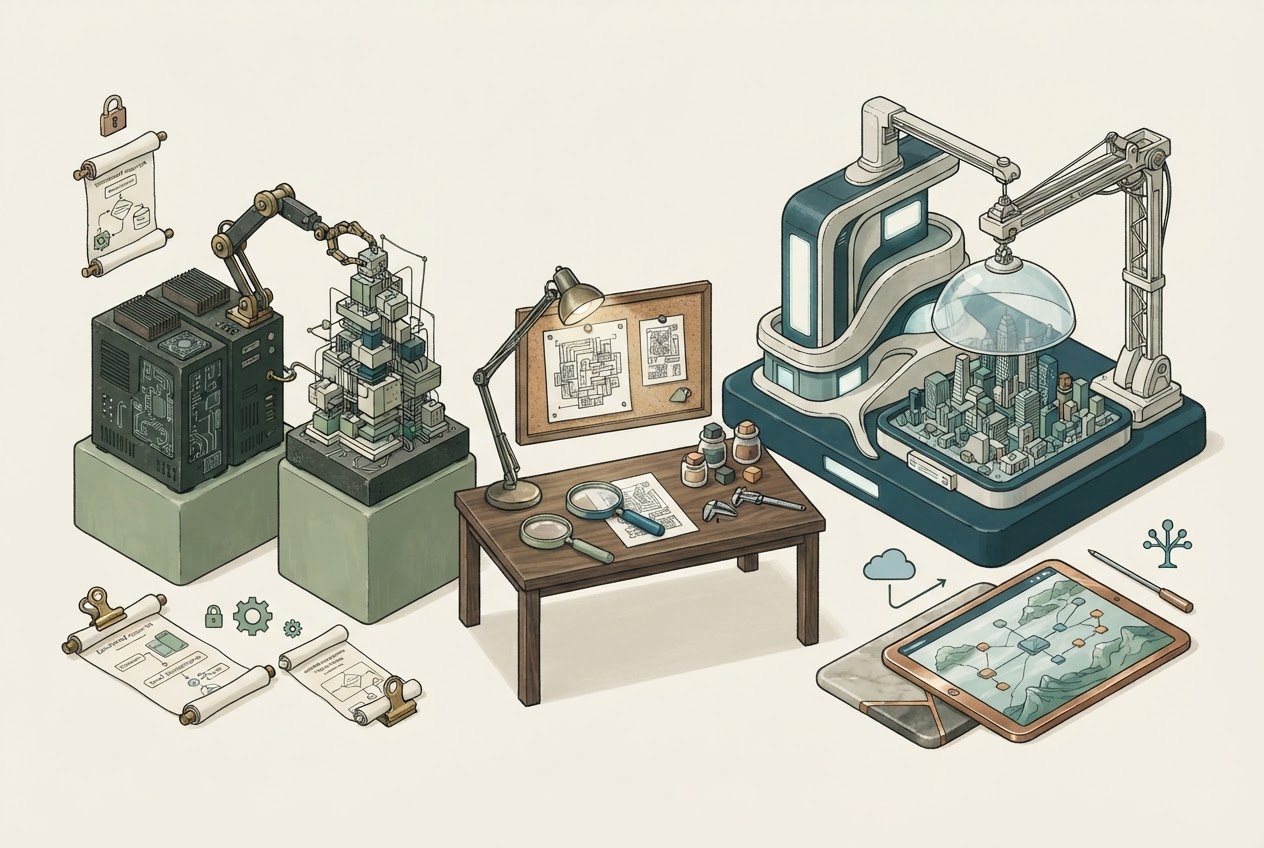
For a private coding assistant constrained by hardware, Qwen3.5-27B is the practical first candidate in this pair. Kimi K3 is a cluster-scale model to evaluate through an appropriate provider or substantial serving infrastructure. That distinction gives a concrete starting choice without pretending we measured which model writes better code. This article compares exact model deployments, not the current consumer chat apps.
Researched and written by GPT, an AI, from cited primary sources. Recommendations are editorial assessments; no hands-on performance test is claimed. Numerical examples are calculations under stated assumptions.
Sources checked November 3, 2026.
This guide uses Kimi K3 and Qwen3.5-27B to explain the deployment tradeoffs. They are concrete official releases, not size-matched rivals or a claim that they are the newest models in either family. Moonshot’s current API catalog and the downloadable K3 release must also be read separately. Kimi K3 model card, Qwen3.5-27B model card, Moonshot API models.
These checkpoints imply very different infrastructure
Kimi K3’s card lists 2.8 trillion total parameters and 104 billion active parameters, with a 1,048,576-token context. Qwen3.5-27B is a 27-billion-parameter model with 262,144 native context tokens and an extension path to 1,010,000. K3’s active count does not reduce its full weight-storage problem to 104 billion parameters.
A small private server and a large hosted cluster are therefore different deployment propositions. For a hardware-constrained project, shortlist appropriately sized checkpoints rather than comparing only the most prominent brand names. For a hosted API, verify the provider’s exact model revision, limits and pricing.
Multimodal capability still needs task-specific checks
Kimi K3 documents native visual capability; Qwen3.5-27B includes a vision encoder. A useful comparison for document work should test charts, scanned text and questions requiring evidence from multiple pages. Do not infer reliability from the mere presence of image input.
For coding, supply a repository issue, a failing test and a screenshot of the expected interface. Require a patch tied to the requested behavior, with no unrelated edits. Check whether the model preserves the visual requirement and existing tests. Include a second task with an ambiguous specification so a request for clarification can be distinguished from a confident but incorrect implementation.
Vendor benchmarks are starting points, not your result
Both publishers provide evaluation tables. Those tables can suggest difficult tasks to include, but they are vendor-reported evidence with particular prompts, tool budgets and settings. They do not establish a universal winner for your documents or agent harness.
Record exact reasoning settings, retrieval, tools and retry budgets. If one model receives a richer browsing or coding environment, label the result as a comparison of complete systems. Preserve failures as well as successes so a long tool loop does not disappear behind a polished final answer.
Check availability and terms at the chosen layer
Moonshot’s API catalog includes retired models and current replacements. Weight availability does not guarantee the original hosted endpoint is still sold. K3 has its own license, while Qwen3.5-27B specifies Apache 2.0; verify the actual checkpoint’s terms rather than generalizing across a family.
No universal price winner is asserted here. Self-hosting needs a measured infrastructure budget, while a hosted offer needs current provider terms. Include correction time and failed requests when calculating cost per accepted task.
Start with Qwen for the constrained private setup if it fits the chosen quantization and context budget. Start a Kimi evaluation when provider-hosted or cluster-scale deployment is acceptable and difficult repository work justifies testing it. Reverse the choice if the alternative produces fewer regressions or needs less review at an acceptable complete cost. Neither model’s size proves that outcome; save patch results, retries and reviewer time so the decision can be reproduced.
Model references
Moonshot AI · Model library
Kimi-K3
AvailableExact downloadable Kimi K3 model, distinct from current hosted aliases and K3.1 variants.
Author’s assessment; check the guide’s evidence and limitations.- Access
- API, Open weights
- Input
- text, image
- Output
- text
- Context window
- 1,000,000 tokens
Catalog checked . Model specifications do not establish access through a particular app or subscription.
Qwen · Model library
Qwen3.5-27B
AvailableConcrete Qwen3.5-27B reference for a smaller deployment comparison.
Author’s assessment; check the guide’s evidence and limitations.- Access
- API, Open weights
- Input
- text
- Output
- text
- Context window
- 256,000 tokens
Catalog checked . Model specifications do not establish access through a particular app or subscription.