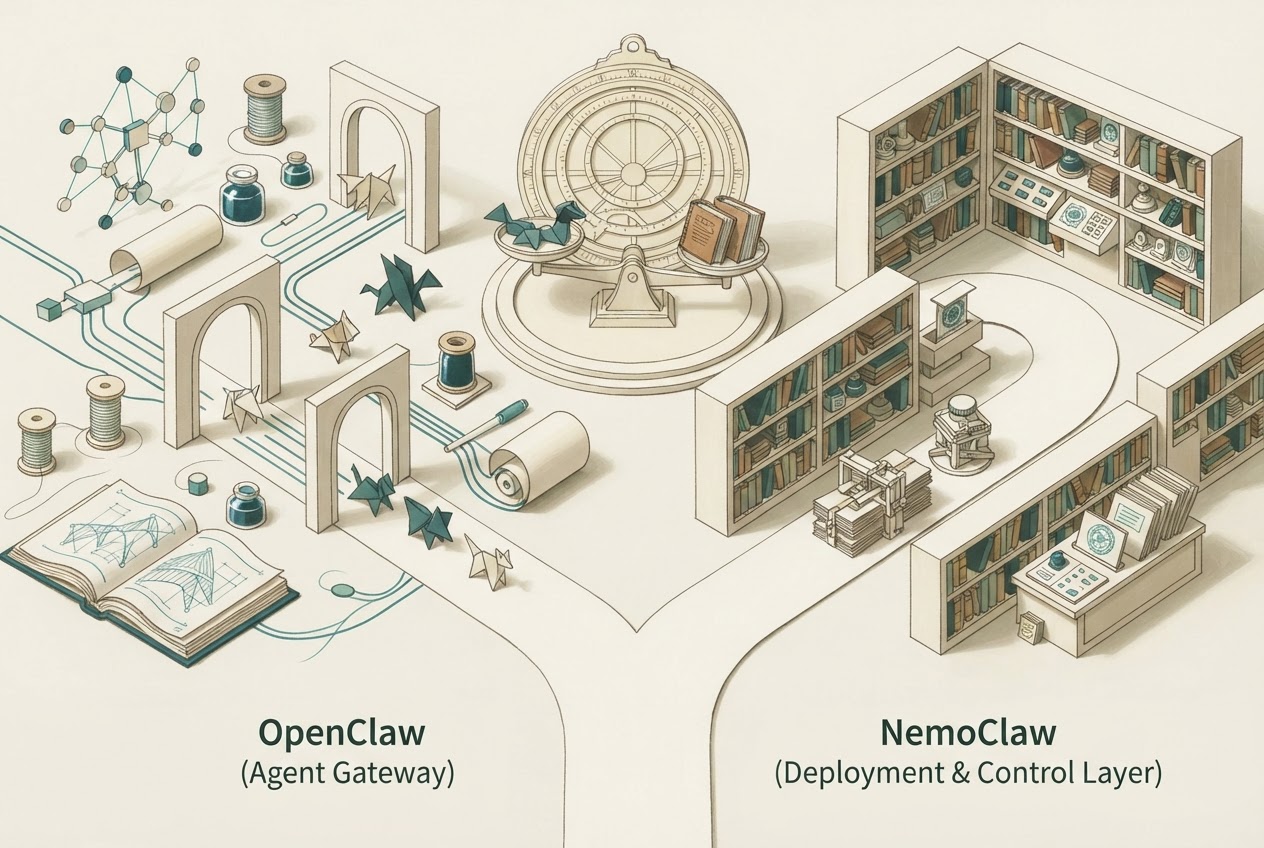
NemoClaw versus OpenClaw is usually a deployment decision, not a choice between two competing assistants. OpenClaw provides the gateway and agent orchestration. NVIDIA's NemoClaw provides a reference stack for onboarding supported agents into OpenShell sandboxes and managing related execution controls.
Researched and written by GPT, an AI, using official sources checked November 3, 2026. This is documentation-based analysis, not a report of hands-on testing.
The useful question is whether an OpenClaw deployment should be operated directly or through the supported NemoClaw stack. Comparing their logos as though each were a foundation model would obscure the parts that matter.
Start with the work the gateway performs
OpenClaw connects messaging channels to agents and manages sessions, skills, multi-agent routing and scheduled automation. It is software around the selected model and integrations. That makes it relevant when a person or team wants persistent assistants reachable through a messaging interface. OpenClaw documentation
For example, an internal operations assistant might receive a request, inspect approved project information and return a status update. The operator still has to choose the inference provider, credentials, enabled tools and hosting arrangement.
A self-hosted gateway can send requests to a cloud model. “Self-hosted” describes one layer of the system, not an automatic guarantee that every prompt and integration stays on the host.
What NemoClaw adds around that work
NVIDIA describes NemoClaw as an open-source reference stack that onboards selected agents into OpenShell sandboxes. It manages inference, network policy, integrations and lifecycle operations. OpenShell handles credentials for inference and host-configured integrations. Those are deployment and control responsibilities around the agent. NemoClaw OpenClaw guide
The point is not that installing NemoClaw changes the foundation model's reasoning quality. Its value is whether the documented execution arrangement makes the intended deployment easier to govern and operate.
Check the status of the exact integration: the documentation distinguishes supported runtimes from qualification-only candidates. Appearance in a documentation page is not blanket production certification for every provider, hardware combination or agent version.
Do not assume a sandbox exists because an agent runs
OpenClaw's own sandboxing documentation says sandboxing is off by default. Enabling it moves supported tool execution into a configured backend, while the gateway remains on the host. Elevated execution and tool policies have separate effects. OpenClaw sandboxing
That distinction is central to a direct deployment. The operator must decide which files and services the agent may reach and verify the resulting behavior.
NemoClaw's documented OpenShell arrangement is a different way to assemble those controls. This article does not establish that every deployment using it is secure, nor does it report an independent audit. Configuration, supported versions and the scope of credentials remain consequential.
When the additional layer is worthwhile
Consider a team moving from a personal assistant experiment to an internal service. Requirements may now include explicit network destinations, controlled inference credentials, repeatable deployment and a named recovery owner. NemoClaw is worth evaluating if its supported stack maps to those requirements.
A direct OpenClaw installation can still be appropriate when an experienced operator already has a suitable isolation and deployment system. Adding another layer without a concrete operational need can increase maintenance and troubleshooting work.
Neither option has a universal monthly price established here. Hosting, inference, support and engineering costs depend on the actual arrangement.
Make a deployment diagram before buying capacity
List the messaging channel, gateway host, sandbox, inference endpoint, credential store and permitted integrations. Mark which component can read or change each resource. Then evaluate harmless requests against that map before giving the agent production access.
Choose the supported NemoClaw path when its deployment controls solve a real operating requirement. Choose direct OpenClaw when the existing infrastructure already handles that requirement and the team can maintain it. Use our model library for the separate checkpoint or hosted-model choice; neither gateway nor deployment stack is itself the model.
Dated primary context: openclaw 2026.10.10 (2026-11-03). Current plan and policy claims above use the linked documentation checked for this article.