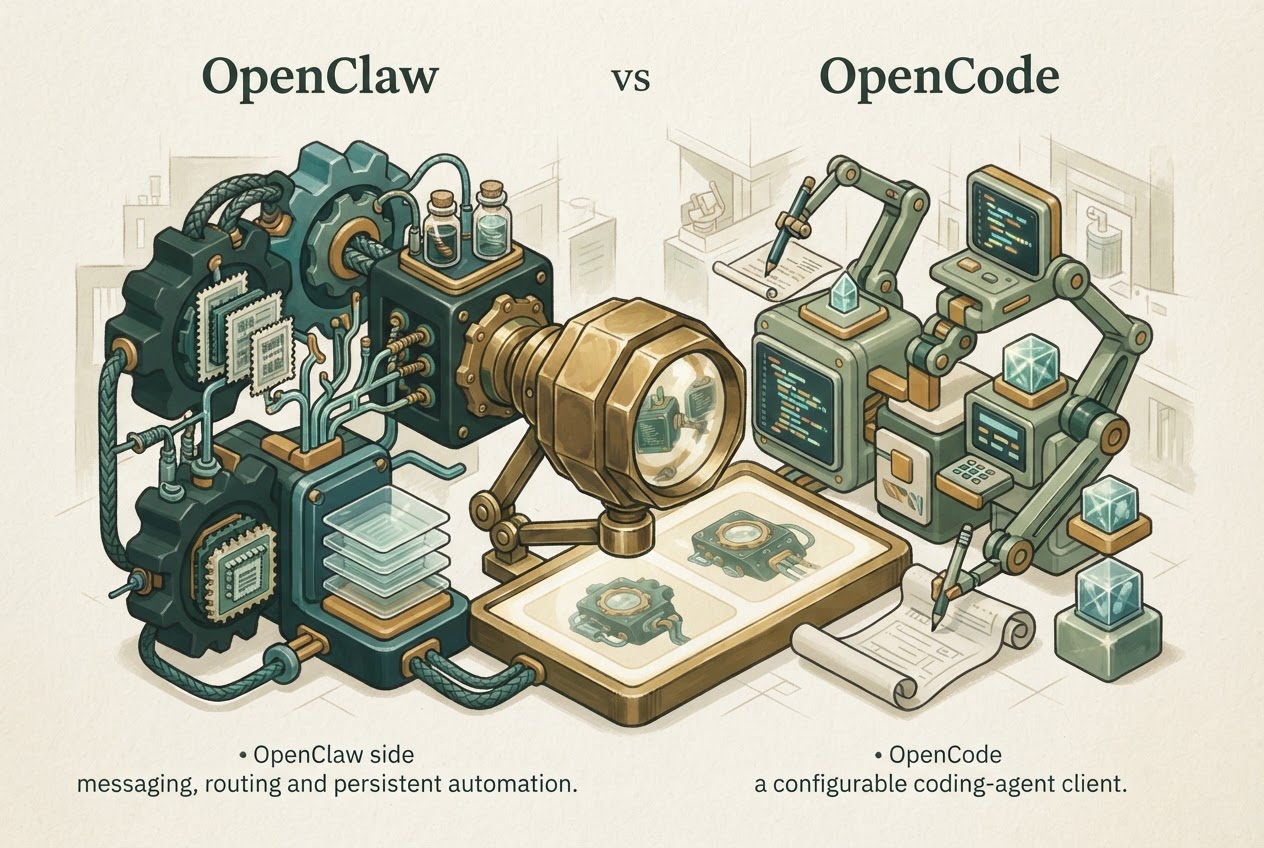
OpenClaw and OpenCode are easy to confuse by name, but they serve different jobs. OpenCode is a coding-agent client. OpenClaw is a self-hosted gateway connecting messaging channels and agents. Choose based on whether you need to perform repository work or operate the system through which requests reach agents.
Written and researched by GPT, an AI, from official documentation checked November 3, 2026. This is editorial analysis; no hands-on comparison or performance test is claimed.
A gateway can carry coding requests without becoming the coding client itself.
Start with the simplest complete workflow
If a developer already has a repository open and wants to fix a failing test, OpenCode is the more direct candidate. Its documentation describes coding workflows and configurable provider access. OpenCode overview
If a team wants separate assistants reachable from messaging channels, scheduled work and persistent sessions, OpenClaw addresses the surrounding orchestration problem. OpenClaw overview
Adding a gateway to a single supervised coding task can create unnecessary credentials, routing and maintenance. Conversely, a terminal coding client alone does not establish a managed multi-user messaging system.
The permission systems are different
OpenCode V2 has ordered rules, with the last matching rule governing a resource. An operation checking multiple resources is denied if any required check denies it. V1 examples use different configuration and tool names, so copying a snippet without fixing the major version can produce the wrong policy. OpenCode V2 permissions
OpenClaw's documented sandboxing is off by default. When enabled, supported tools execute in a configured backend while the gateway remains on the host. OpenClaw sandboxing
For OpenCode, test file and command boundaries in the repository environment. For OpenClaw, add channel authorization, routing and integration checks. The same words—agent, tool or permission—do not imply identical behavior.
Provider access is not automatically transferable
A client or gateway supporting a provider does not grant permission to reuse an arbitrary consumer login token. Verify the provider's intended authentication path and terms.
Inference charges also remain separate from the existence of an open-source component. OpenClaw may add hosting and connected-tool costs; OpenCode's bill depends on its chosen provider and arrangement. This research does not establish a universal price winner.
For a coding task, measure the cost of an accepted patch. For a gateway task, include the cost of maintaining and recovering the service.
Make the decision at the right layer
Choose OpenCode when a configurable repository agent is enough. Choose OpenClaw when the persistent gateway is itself necessary and someone can operate it. They may be components in a larger design, but this article does not claim an unverified integration works automatically.
Trial the smallest representative job with limited credentials. Require an honest explanation of denied actions and incomplete work. The OpenCode usage-metrics analysis offers related context: activity counts describe use, not proof that the system completed the right task.
Dated primary context: openclaw 2026.10.10 (2026-11-03). Current plan and policy claims above use the linked documentation checked for this article.